

CKD Symptoms: Early Signs and Treatment Options in Webster, TX
Chronic Kidney Disease (CKD) can quietly compromise your health long before severe symptoms appear. For residents of Webster, TX, recognizing early warning signs—such as persistent fatigue, muscle cramps, and noticeable changes in urination—is essential for timely intervention. At Primary Care of Clear Lake, Dr. Smriti Choudhary, M.D., and Dr. Niraj Choudhary, M.D., provide professional diagnostic evaluations and customized treatment options to protect your renal health. For more information, please contact us or schedule an appointment online. We are conveniently located at 13920 Osprey Ct, Suite C, Webster, TX 77598.
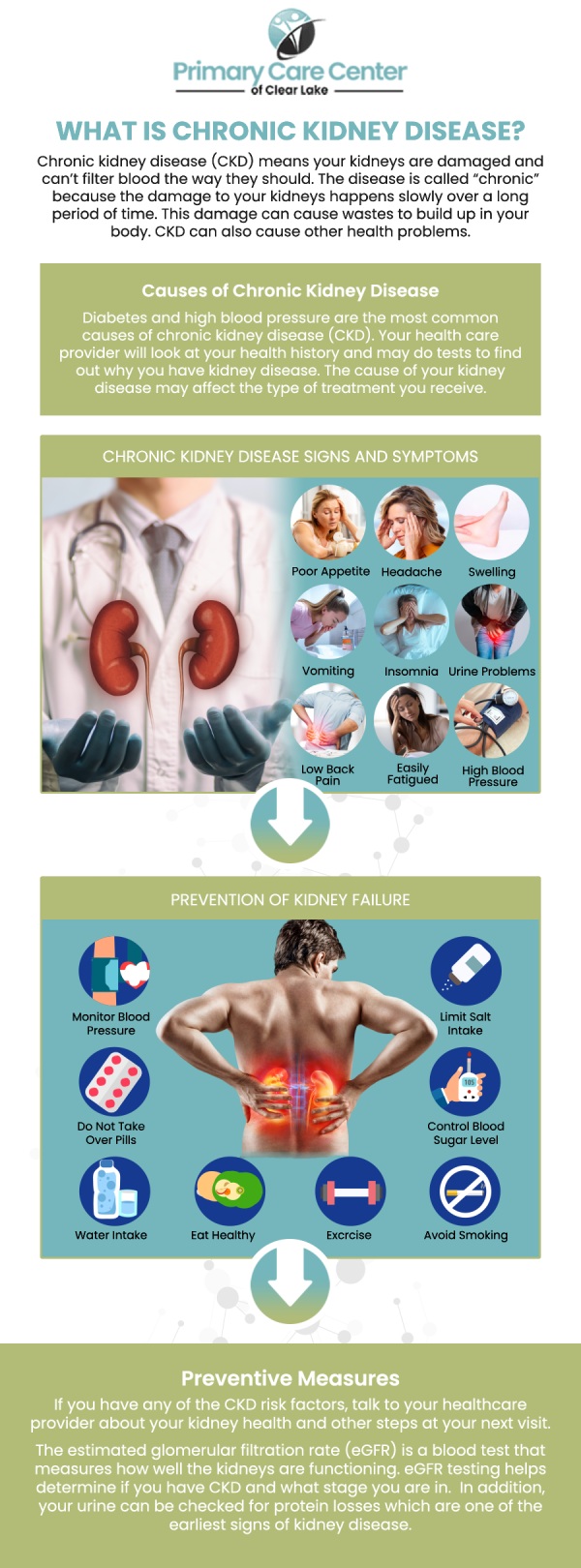
Table of Contents:
What are the most common early symptoms of Chronic Kidney Disease (CKD)?
Which warning signs of kidney problems require immediate medical attention?
How is Chronic Kidney Disease diagnosed during a primary care visit?
When should you schedule a medical evaluation for potential CKD symptoms?
How can Dr. Smriti Choudhary, M.D., and Dr. Niraj Choudhary, M.D., at Primary Care of Clear Lake help Webster, TX patients manage early CKD?
Chronic Kidney Disease (CKD) often develops gradually, and in its early stages, symptoms can be subtle or easily overlooked. At Primary Care Center of Clear Lake, our team is dedicated to helping patients recognize and manage CKD as early as possible to ensure better long-term outcomes.
Some of the most common early signs of CKD include increased fatigue and a general feeling of tiredness. This happens because the kidneys are less able to filter waste from the blood, leading to a buildup of toxins that can make you feel weak. Changes in urination patterns—such as urinating more often (especially at night), or noticing foamy, bubbly, or blood-tinged urine—are also frequently reported by our patients.
Swelling in the legs, ankles, feet, or even around the eyes may develop as the kidneys begin to struggle with balancing fluids and eliminating excess salt and water from the body. Persistent itching, loss of appetite, nausea, and even vomiting can also occur as waste products accumulate in the bloodstream. Some patients also report difficulty concentrating or episodes of confusion, which result from the chemical imbalances caused by declining kidney function.
Because these early symptoms of CKD are often mild and nonspecific, they can easily be mistaken for other health issues. That’s why at Primary Care Center of Clear Lake, we emphasize the importance of regular check-ups and routine blood or urine tests—especially for patients with diabetes, high blood pressure, or a family history of kidney disease.
Early detection is crucial for slowing the progression of CKD and managing symptoms effectively. If you or a loved one are at risk or experiencing any of these symptoms, we encourage you to schedule an appointment with our caring providers. Our team at Primary Care Center of Clear Lake is here to support your kidney health and overall well-being every step of the way.
At Primary Care Center of Clear Lake, your health and well-being are our top priorities. Kidney problems can develop silently but may quickly become serious if warning signs are ignored. Recognizing these symptoms early—and knowing when to seek medical attention—can make a critical difference.
Certain warning signs of kidney problems indicate a potentially serious or rapidly worsening condition that requires immediate medical attention:
• Sudden swelling of the face, hands, feet, or ankles may be a sign your kidneys are not removing excess fluid from your body.
• Significant decrease in urine output—or complete inability to urinate—can signal that your kidneys are not functioning properly.
• Blood in your urine (urine that looks pink, red, or cola-colored) should prompt urgent evaluation, as it may indicate bleeding or severe kidney damage.
• Severe pain in your lower back or sides, especially if sudden and intense, could be due to kidney stones, infection, or other acute kidney issues.
• Confusion, drowsiness, or difficulty staying awake may be related to a dangerous buildup of toxins in the body due to kidney failure.
• Shortness of breath, chest pain, or irregular heartbeat can occur when fluid overload or electrolyte disturbances affect the heart and lungs, often as a result of worsening kidney function.
• High fever with chills, especially if accompanied by back pain or painful urination, may indicate a severe kidney infection (pyelonephritis) that can quickly become life-threatening if untreated.
• Persistent nausea, vomiting, or a metallic taste in your mouth can also be signs of advanced kidney dysfunction.
If you or a loved one experiences any of these symptoms, do not wait. Immediate medical evaluation is essential to prevent irreversible kidney damage and serious complications. The experienced team at Primary Care Center of Clear Lake is here to help.
At the Primary Care Center of Clear Lake, we are committed to early detection and effective management of chronic conditions, including Chronic Kidney Disease (CKD). CKD is often identified during routine primary care visits through a thorough evaluation process that our experienced providers perform.
Our Diagnostic Approach:
During your visit, our healthcare team will review your medical history and ask about common CKD symptoms such as fatigue, leg swelling, changes in urination, and any history of diabetes or high blood pressure—two major risk factors for kidney disease. Our providers understand that CKD can be silent in its early stages, so we pay close attention to both subtle symptoms and underlying health conditions.
A comprehensive physical examination will be conducted to check for signs of fluid retention, elevated blood pressure, and other complications that may indicate kidney dysfunction.
Laboratory Testing at Our Center:
Laboratory tests are a key part of our diagnostic process at Primary Care Center of Clear Lake. We routinely order blood tests to measure serum creatinine, which allows us to estimate your glomerular filtration rate (eGFR)—an important indicator of how well your kidneys are filtering waste. If your eGFR remains below 60 mL/min/1.73 m² for three months or longer, this may suggest chronic kidney disease.
We also perform urine tests, including the urine albumin-to-creatinine ratio (UACR), to detect even small amounts of protein in your urine (proteinuria or albuminuria). This helps us identify early kidney damage before more obvious symptoms develop.
Further Evaluation When Needed:
If necessary, we may recommend imaging studies such as a kidney ultrasound to assess the size and structure of your kidneys or to rule out other possible causes of kidney problems.
If you are experiencing signs or symptoms that may suggest chronic kidney disease (CKD), it is important to schedule a medical evaluation promptly. At the Primary Care Center of Clear Lake, our healthcare providers are here to help you identify and manage potential kidney problems early.
You should consider making an appointment with our team if you notice persistent swelling in your legs, ankles, feet, or around your eyes, as this may indicate fluid retention related to kidney issues. Unexplained fatigue, weakness, or decreased energy levels can also be early indicators of CKD and should not be ignored. Changes in urination—such as producing less urine than usual, foamy or bubbly urine, blood in the urine, or needing to urinate frequently at night—are additional signs that warrant a thorough evaluation.
Other concerning symptoms include persistent high blood pressure, difficulty concentrating, loss of appetite, muscle cramps, itching, or nausea and vomiting. If you have risk factors for CKD, such as diabetes, high blood pressure, a family history of kidney disease, or are over the age of 60, we recommend discussing routine kidney function testing with your provider—even if you have no symptoms. The Primary Care Center of Clear Lake offers comprehensive screenings and individualized care to support your kidney health.
At the Primary Care Center of Clear Lake, Dr. Smriti Choudhary, M.D., and Dr. Niraj Choudhary, M.D., provide patient-centered care for individuals in Webster, TX, who are living with early-stage chronic kidney disease (CKD). Our team begins with thorough assessments, including kidney function lab panels and urine analysis, to accurately diagnose CKD and determine its stage.
Once CKD is identified, Drs. Smriti and Niraj Choudhary develop individualized treatment plans tailored to each patient’s unique needs. We focus on managing underlying health conditions—such as high blood pressure, diabetes, and heart disease—that are critical to slowing kidney disease progression. Our approach emphasizes practical lifestyle modifications, including kidney-friendly dietary guidance, exercise recommendations, and weight management strategies.
Our commitment to regular follow-up means that we closely monitor each patient’s kidney health, adjusting treatment plans as needed and addressing any new symptoms promptly. At the Primary Care Center of Clear Lake, we empower our Webster community with the knowledge and support they need to take an active role in their kidney health—helping to slow CKD progression and enhance quality of life. For more information, please contact us or schedule an appointment online. We are conveniently located at 13920 Osprey Ct, Suite C, Webster, TX 77598. We serve patients from Webster TX, Bacliff TX, Dickinson TX, Seabrook TX, League City TX, Clear Lake City TX, and surrounding areas.
Check Out Our 5 Star Reviews


Additional Services We Offer
• 2D ECHO
• ABI Testing
• Obesity Medicine
• Alzheimer’s Disease
• Anxiety Disorder
• Aortic Aneurysm Screening
• Arthritis
• Asthma
• Body Composition Testing
• Cancer Screening
• Carotid Doppler
• Chronic Condition Management
• Chronic Kidney Disease
• Chronic Obstructive Pulmonary Disease
• Congestive Heart Failure
• COPD & Asthma
• Coronary Heart Disease
• COVID-19 Testing
• Dementia Screening
• Depression
• Diabetes Management
• EKG
• Food Allergies
• Food Sensitivity
• Geriatric Care
• Hypertension
• Wegovy HD
• Outdoor Allergies
• Parkinson’s Disease
• Primary Care
• Resting Metabolic Rate Testing
• Thyroid Scan
• Wellness Exams for Men
• Wellness Exams for Women
• Ozempic
• Integrative Medical Weight Loss
• Men’s Health
• Testosterone Replacement Therapy
• Erectile Dysfunction
• Testosterone Gel and Injections
• Women’s Health
• Menopause
• PCOS
• Hormone Replacement Therapy
• Individual Nutritional and Lifestyle Counselling
• Indoor Allergies
• Internal Medicine
• Lipid Disorders
• Medical Weight-Loss
• Osteoporosis
• Foundayo
• Flu Shot

Additional Services We Offer
• 2D ECHO
• ABI Testing
• Obesity Medicine
• Alzheimer’s Disease
• Anxiety Disorder
• Aortic Aneurysm Screening
• Arthritis
• Asthma
• Body Composition Testing
• Cancer Screening
• Carotid Doppler
• Chronic Condition Management
• Chronic Kidney Disease
• Chronic Obstructive Pulmonary Disease
• Congestive Heart Failure
• COPD & Asthma
• Coronary Heart Disease
• COVID-19 Testing
• Dementia Screening
• Depression
• Diabetes Management
• EKG
• Food Allergies
• Food Sensitivity
• Geriatric Care
• Hypertension
• Outdoor Allergies
• Parkinson’s Disease
• Primary Care
• Resting Metabolic Rate Testing
• Thyroid Scan
• Wellness Exams for Men
• Wellness Exams for Women
• Ozempic
• Integrative Medical Weight Loss
• Men’s Health
• Testosterone Replacement Therapy
• Erectile Dysfunction
• Testosterone Gel and Injections
• Women’s Health
• Menopause
• PCOS
• Hormone Replacement Therapy
• Individual Nutritional and Lifestyle Counselling
• Indoor Allergies
• Internal Medicine
• Lipid Disorders
• Medical Weight-Loss
• Osteoporosis
• Foundayo
• Wegovy HD
• Flu Shot


 Send Text
 How May I Help You?