

How Is Chronic Kidney Disease (CKD) Diagnosed and Managed in Webster TX?
Diagnosing Chronic Kidney Disease starts with a thorough evaluation by our experienced team, using precise tests to assess kidney function early on. Once diagnosed, our board-certified professionals focus on slowing disease progression by managing underlying conditions like hypertension and diabetes through personalized medications, lifestyle changes, and nutritional advice. At Primary Care of Clear Lake, Dr. Smriti Choudhary, M.D., and Dr. Niraj Choudhary, M.D. provide compassionate, proactive care aimed at preserving your renal health and enhancing your quality of life. For more information, please contact us or schedule an appointment online. We are conveniently located at 13920 Osprey Ct, Suite C, Webster, TX 77598.
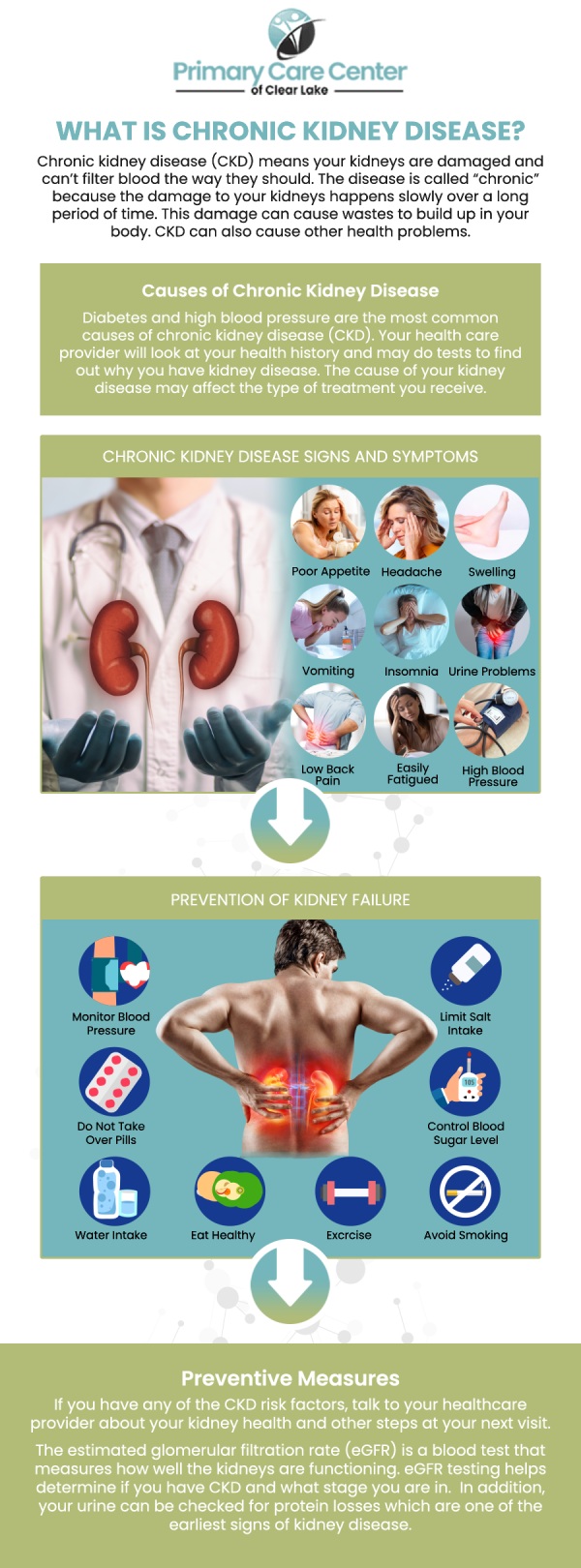

Table of Contents:
What tests are used to detect chronic kidney disease (CKD)?
How often should kidney function be monitored in CKD patients?
What stages are used to classify chronic kidney disease (CKD)?
How is chronic kidney disease (CKD) managed in its early stages?
Specialist Care for Chronic Kidney Disease (CKD) with Dr. Niraj Choudhary, MD and Dr. Smriti Choudhary, MD
At Primary Care of Clear Lake, we understand that a chronic kidney disease (CKD) diagnosis can feel overwhelming. However, with the right medical team and a proactive approach, you can effectively manage your condition and maintain your quality of life. Understanding how this condition is diagnosed, monitored, and treated is your first step toward long-term wellness.
Detecting chronic kidney disease (CKD) early is critical for preserving your kidney function and preventing long-term complications. Because early-stage kidney disease often presents no physical symptoms, physicians rely on specific diagnostic tests to accurately evaluate how well your kidneys are filtering waste. The most fundamental assessment is a blood test used to calculate your estimated Glomerular Filtration Rate (eGFR). This test measures the level of creatinine—a waste product from muscle breakdown—in your blood. A low eGFR indicates that your kidneys are struggling to filter waste efficiently.
In addition to blood work, a routine urinalysis is essential. We look specifically for the presence of albumin, a type of protein. An Albumin-to-Creatinine Ratio (ACR) test determines if protein is leaking into your urine, which is one of the earliest markers of kidney damage. If these initial tests indicate an abnormality, your doctor may recommend imaging studies, such as a renal ultrasound, to visually inspect the size, shape, and structure of your kidneys and rule out obstructions like kidney stones or tumors. In rare, complex cases, a kidney biopsy might be performed to determine the exact cause of the damage.
Once you are diagnosed with chronic kidney disease, regular monitoring becomes a cornerstone of your long-term healthcare plan. The frequency of your kidney function tests depends entirely on the current stage of your disease, the stability of your kidney function, and the presence of underlying health conditions like diabetes or high blood pressure. For patients in the very early stages of CKD (Stages 1 and 2) with well-controlled risk factors, your doctor may only require monitoring once a year to ensure your condition remains stable.
However, as the disease progresses, more frequent medical supervision is necessary. Patients in Stage 3 CKD typically need their kidney function, blood pressure, and related lab work checked every three to six months. For those in the advanced stages (Stages 4 and 5), monitoring is highly rigorous, often requiring comprehensive evaluations every one to three months. Regular check-ups allow your healthcare provider to track any rapid declines in your eGFR, adjust your medications, and swiftly address complications like anemia or electrolyte imbalances. Consistent, proactive monitoring at Primary Care of Clear Lake ensures that we can implement timely interventions to protect your remaining kidney function.
Chronic kidney disease is medically classified into five distinct stages, categorized primarily by your estimated Glomerular Filtration Rate (eGFR). This staging system helps doctors determine the severity of kidney damage and design an appropriate treatment protocol. Stage 1 represents mild kidney damage with a normal or high eGFR (90 or above); at this point, the kidneys still function well, but physical damage or protein in the urine is present. Stage 2 indicates a mild decline in kidney function, with an eGFR between 60 and 89.
Stage 3 is a critical turning point and is split into two phases: Stage 3a (eGFR 45-59) and Stage 3b (eGFR 30-44). In this moderate stage, waste products begin accumulating in the blood, and patients may start experiencing early symptoms or complications. Stage 4 signifies a severe decline in kidney function, with an eGFR dropping to between 15 and 29. Finally, Stage 5—often referred to as End-Stage Renal Disease (ESRD)—occurs when the eGFR falls below 15. At this critical stage, the kidneys have completely failed or are close to failure, necessitating life-sustaining treatments such as dialysis or a kidney transplant.
Managing chronic kidney disease in its early stages revolves around a clear goal: slowing the progression of the disease and preserving as much kidney function as possible. Because kidney damage is typically irreversible, early intervention focuses heavily on controlling the underlying conditions that stress the organs. The absolute most effective strategy is strictly managing high blood pressure and diabetes. Your doctor will likely prescribe specific blood pressure medications, such as ACE inhibitors or ARBs, which have proven protective effects on the kidneys beyond just lowering blood pressure.
Dietary and lifestyle adjustments are equally paramount. Patients are strongly advised to adopt a kidney-friendly diet that significantly limits sodium intake to control fluid retention and blood pressure. Depending on your specific labs, you might also need to moderate your intake of dietary protein to reduce the kidneys’ workload. Routine exercise, achieving a healthy weight, and quitting smoking are vital lifestyle changes that enhance cardiovascular health and, by extension, kidney function. Furthermore, your provider will counsel you to avoid nephrotoxic drugs, particularly over-the-counter nonsteroidal anti-inflammatory drugs (NSAIDs) like ibuprofen or naproxen, which can cause sudden and severe damage to already compromised kidneys.
Navigating a chronic kidney disease diagnosis requires compassionate, expert medical guidance tailored to your unique health profile. In Webster, TX, patients rely on the dedicated expertise of Dr. Niraj Choudhary, MD, and Dr. Smriti Choudhary, MD, at Primary Care of Clear Lake. Both physicians bring extensive experience in internal medicine and chronic disease management, recognizing that treating kidney disease means treating the whole patient. Rather than simply monitoring declining labs, they proactively target the root causes of renal damage, offering cutting-edge management for complex comorbidities like diabetes, hypertension, and obesity.
When you partner with Dr. Niraj or Dr. Smriti Choudhary, you receive a highly personalized, comprehensive care plan. They utilize the latest diagnostic advancements, including in-house lab evaluations and continuous metabolic assessments, to track your kidney health with precision. Beyond clinical testing, they prioritize patient education—ensuring you thoroughly understand your dietary needs, medication adjustments, and lifestyle interventions. If your condition requires advanced intervention, they coordinate seamlessly with local nephrologists to guarantee continuity of care. Don’t leave your kidney health to chance; trust the highly-rated, patient-centered specialists at Primary Care of Clear Lake to protect your long-term wellness. For more information, please contact us or schedule an appointment online. We are conveniently located at 13920 Osprey Ct, Suite C, Webster, TX 77598. We serve patients from Webster TX, Bacliff TX, Dickinson TX, Seabrook TX, League City TX, Clear Lake City TX, and surrounding areas.
Check Out Our 5 Star Reviews


Additional Services We Offer
• 2D ECHO
• ABI Testing
• Obesity Medicine
• Alzheimer’s Disease
• Anxiety Disorder
• Aortic Aneurysm Screening
• Arthritis
• Asthma
• Body Composition Testing
• Cancer Screening
• Carotid Doppler
• Chronic Condition Management
• Chronic Kidney Disease
• Chronic Obstructive Pulmonary Disease
• Congestive Heart Failure
• COPD & Asthma
• Coronary Heart Disease
• COVID-19 Testing
• Dementia Screening
• Depression
• Diabetes Management
• EKG
• Food Allergies
• Food Sensitivity
• Geriatric Care
• Hypertension
• Wegovy HD
• Outdoor Allergies
• Parkinson’s Disease
• Primary Care
• Resting Metabolic Rate Testing
• Thyroid Scan
• Wellness Exams for Men
• Wellness Exams for Women
• Ozempic
• Integrative Medical Weight Loss
• Men’s Health
• Testosterone Replacement Therapy
• Erectile Dysfunction
• Testosterone Gel and Injections
• Women’s Health
• Menopause
• PCOS
• Hormone Replacement Therapy
• Individual Nutritional and Lifestyle Counselling
• Indoor Allergies
• Internal Medicine
• Lipid Disorders
• Medical Weight-Loss
• Osteoporosis
• Foundayo
• Flu Shot

Additional Services We Offer
• 2D ECHO
• ABI Testing
• Obesity Medicine
• Alzheimer’s Disease
• Anxiety Disorder
• Aortic Aneurysm Screening
• Arthritis
• Asthma
• Body Composition Testing
• Cancer Screening
• Carotid Doppler
• Chronic Condition Management
• Chronic Kidney Disease
• Chronic Obstructive Pulmonary Disease
• Congestive Heart Failure
• COPD & Asthma
• Coronary Heart Disease
• COVID-19 Testing
• Dementia Screening
• Depression
• Diabetes Management
• EKG
• Food Allergies
• Food Sensitivity
• Geriatric Care
• Hypertension
• Outdoor Allergies
• Parkinson’s Disease
• Primary Care
• Resting Metabolic Rate Testing
• Thyroid Scan
• Wellness Exams for Men
• Wellness Exams for Women
• Ozempic
• Integrative Medical Weight Loss
• Men’s Health
• Testosterone Replacement Therapy
• Erectile Dysfunction
• Testosterone Gel and Injections
• Women’s Health
• Menopause
• PCOS
• Hormone Replacement Therapy
• Individual Nutritional and Lifestyle Counselling
• Indoor Allergies
• Internal Medicine
• Lipid Disorders
• Medical Weight-Loss
• Osteoporosis
• Foundayo
• Wegovy HD
• Flu Shot


 Send Text
 How May I Help You?