

Whole Body DEXA Scan for Metabolic Health in Pasadena TX
A whole-body DEXA scan provides a detailed look at body composition, including body fat, lean mass, and how these tissues are distributed throughout the body. Unlike body weight or BMI alone, DEXA can help show whether changes in weight are coming from fat, muscle, or other components of body composition. At Primary Care Center of Clear Lake in Pasadena, TX, Dr. Smriti Choudhary, MD and Dr. Niraj Choudhary, MD are board-certified in internal medicine and obesity medicine. The practice offers DEXA body-composition testing along with medical weight management, metabolic assessment, nutrition and lifestyle counseling, and other primary care services. For more information, contact us or schedule an appointment online. We are conveniently located at 5150 Crenshaw Rd, Suite A 150, Pasadena, TX 77505.
Check Our Offers

Dexa Scan
Full Body Dexa Scan for $100
Redeem it now!
Dexa Scan
Full Body Dexa Scan for $100
Redeem it now!


Table of Contents:
What can a DEXA scan reveal about body fat, lean mass, and fat distribution?
Who may benefit from a whole-body DEXA scan, and what are its limitations when assessing metabolic health?
How should I prepare for a DEXA scan, and what can I expect during the appointment?
What are the safety considerations for a whole-body DEXA scan, and who should avoid or postpone it?
How can Dr. Smriti Choudhary, MD use DEXA results to personalize nutrition, exercise, and weight-management recommendations?
Is a whole-body DEXA scan the same as a bone-density test?
Can DEXA show how much body fat I have?
Is DEXA more useful than BMI?
Can a DEXA scan diagnose metabolic syndrome?
Can DEXA be used to monitor weight-loss progress?
Is a DEXA scan safe during pregnancy?
Whole Body DEXA Scan in Pasadena, TX
Medical References
DEXA, which stands for dual-energy X-ray absorptiometry, uses low-energy X-rays to estimate different components of the body. A whole-body scan can measure total and regional fat mass, lean mass, and bone mineral content.
Depending on the system and report, results may include:
• Total body fat percentage
• Total fat mass
• Lean tissue or lean mass
• Differences in lean mass between body regions
• Fat distribution in the arms, legs, and trunk
• Regional measures of abdominal or central fat
• Bone mineral measurements
This information can be useful because two people with the same weight or BMI may have very different amounts of muscle and body fat. BMI does not directly measure body composition, while DEXA provides additional information about fat and lean tissue.
For patients working on weight management, changes in body composition may also provide more context than changes on a scale alone. For example, a person could lose fat while maintaining or gaining lean mass, even if overall body weight changes more slowly.
Whole-body DEXA may be useful for people who want a more detailed assessment of body composition, particularly when weight, muscle mass, or fat distribution is relevant to their health goals.
It may be considered for patients participating in medically supervised weight-management programs, people experiencing significant changes in weight, or individuals in whom BMI does not provide a complete picture of body composition. Current obesity guidance recognizes body-composition methods such as DEXA as useful in selected patients when additional information about adiposity or lean mass is needed.
DEXA may also help track changes over time when a patient is working on nutrition, exercise, or weight-management goals.
However, a DEXA scan has important limitations. It does not by itself diagnose metabolic disease. It cannot determine whether someone has diabetes, high cholesterol, high blood pressure, fatty liver disease, or another metabolic condition. Those conditions require clinical evaluation and, when appropriate, laboratory testing or other diagnostic studies.
Body-composition measurements can also vary because of hydration, positioning, equipment, recent meals, and other technical factors. For meaningful comparisons, repeat testing is ideally performed under similar conditions and, when possible, using the same equipment.
A whole-body body-composition scan should also not be confused with the standard central DEXA scan used to diagnose osteoporosis. Osteoporosis testing generally focuses on bone mineral density at the hip and lumbar spine rather than relying on a whole-body body-composition measurement.
Whole-body DEXA usually requires little preparation. Patients should follow any specific instructions provided before their appointment.
It is important to tell the healthcare team if you:
• Are pregnant or could be pregnant
• Recently had an imaging test involving contrast material
• Recently underwent a nuclear medicine procedure
• Have implants or other devices that may affect the scan
• Have difficulty lying still or comfortably on an examination table
• Certain contrast materials or radiopharmaceuticals can interfere with DEXA measurements, so the scan may need to be scheduled at a different time.
During a whole-body DEXA scan, the patient generally lies on an open, padded table while a scanning arm passes over the body. The examination is noninvasive and does not require an enclosed scanner. Low-energy X-rays are used to measure differences in bone, lean tissue, and fat tissue.
The patient will usually need to remain still during the scan so the equipment can obtain accurate measurements.
For follow-up body-composition testing, consistency can matter. Hydration status and other short-term factors can affect lean-mass estimates, so comparisons are more useful when scans are performed under similar conditions.
DEXA uses ionizing radiation, but the amount used for a body-composition examination is low. It is generally considered a low-radiation imaging method.
The most important safety consideration is pregnancy. The International Society for Clinical Densitometry identifies pregnancy as a contraindication to DEXA body-composition testing. Patients who are pregnant or think they may be pregnant should notify the healthcare team before the examination.
A scan may also need to be postponed if the patient recently received contrast material or certain radioactive tracers because these can affect the accuracy of the results. Equipment also has physical size and weight limits that may prevent an accurate examination in some patients.
DEXA should be used when the information is expected to contribute meaningfully to clinical care or health monitoring. Because it involves radiation, even at a low dose, repeat scans should be based on an appropriate clinical reason rather than performed unnecessarily.
A DEXA result can provide Dr. Smriti Choudhary, MD with additional information beyond body weight alone when evaluating a patient’s metabolic and weight-management goals.
For example, the results may help identify whether a patient has a relatively high percentage of body fat, reduced lean mass, or changes in body composition during a weight-management program. This information can then be considered alongside the patient’s medical history, laboratory results, medications, physical activity, nutrition habits, blood pressure, and other health factors.
At Primary Care Center of Clear Lake, Dr. Smriti Choudhary, MD and Dr. Niraj Choudhary, MD provide obesity medicine, medical weight management, metabolic assessment, internal medicine, and individualized nutrition and lifestyle counseling.
DEXA findings may help guide discussions about maintaining lean muscle during weight loss, increasing appropriate physical activity, improving nutritional intake, or monitoring changes during a weight-management plan. However, the scan is only one part of the assessment. Recommendations should also reflect the patient’s age, medical conditions, mobility, medications, laboratory findings, and personal health goals.
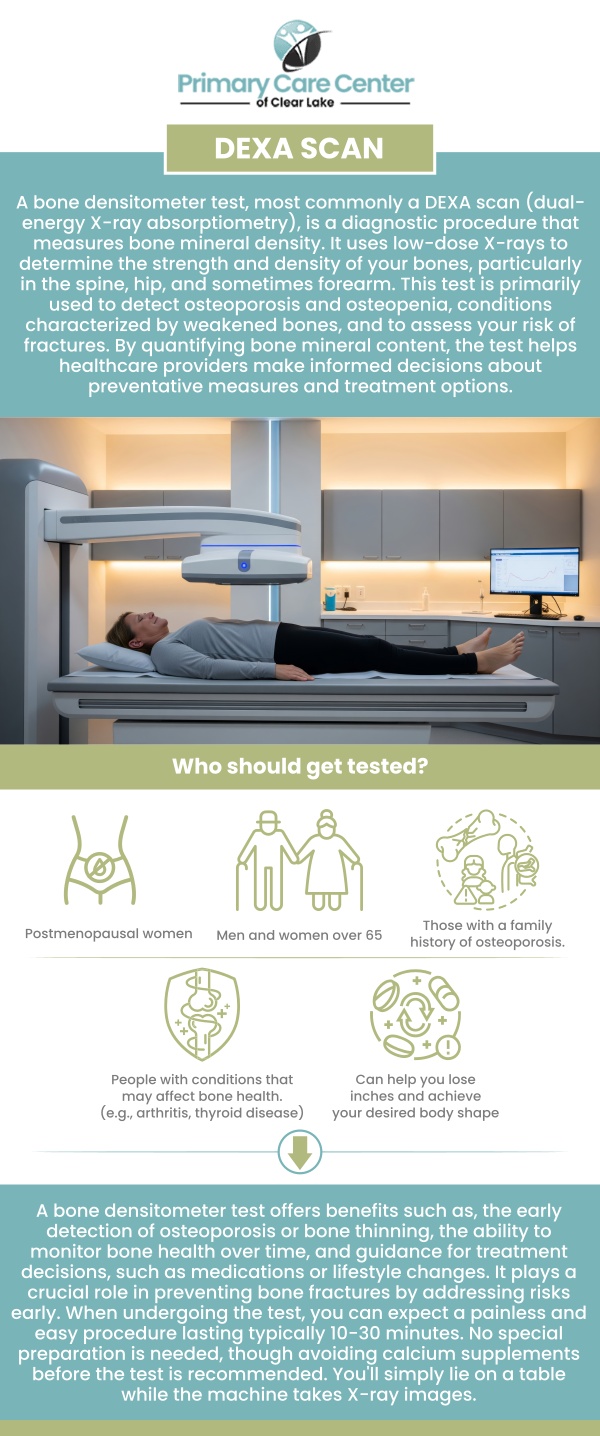
Not exactly. Both use DEXA technology, but a whole-body scan may focus on fat and lean mass. Standard testing for osteoporosis generally measures bone density at the hip and spine.
Yes. A whole-body DEXA scan can estimate total body fat percentage and regional fat distribution, along with lean mass and bone mineral content.
They provide different information. BMI uses height and weight, while DEXA measures body composition. DEXA may provide additional information when BMI does not adequately reflect fat and muscle mass.
No. DEXA can provide information about body composition, but metabolic syndrome and related conditions require assessment of factors such as blood pressure, blood sugar, cholesterol, waist measurements, and overall medical history.
It can help monitor changes in fat mass and lean mass over time, particularly when significant weight change is expected. Results should be interpreted alongside other clinical measures.
No. Pregnancy is considered a contraindication to DEXA body-composition scanning because the examination uses ionizing radiation.
For patients who want more information about their body composition, a whole body DEXA scan in Pasadena, TX can provide measurements that go beyond the number on a scale.
At Primary Care Center of Clear Lake, Dr. Smriti Choudhary, MD and Dr. Niraj Choudhary, MD can consider DEXA findings together with metabolic health, weight history, medical conditions, laboratory testing, nutrition, and lifestyle factors to develop an individualized plan. Patients can contact the Pasadena location to learn whether body-composition testing is appropriate for their health and weight-management goals. For more information, contact us or schedule an appointment online. We are conveniently located at 5150 Crenshaw Rd, Suite A 150, Pasadena, TX 77505. We serve patients from Pasadena TX, South Houston TX, Brookwood TX, Clear Lake TX, Baytown TX, and surrounding areas.
• Primary Care Center of Clear Lake — DEXA Body Composition Scan:
https://primarycareofclearlake.com/dexa-body-composition
• Primary Care Center of Clear Lake — Pasadena Services:
https://primarycareofclearlake.com/pasadena-appointment
• National Institutes of Health, Clinical Center — DEXA:
https://www.cc.nih.gov/radis/nucmed/patient-info
• NIH / National Institute of Arthritis and Musculoskeletal and Skin Diseases — Bone Mineral Density Tests: What the Numbers Mean:
https://www.niams.nih.gov/health-topics/bone-mineral-density-tests-what-numbers-mean
• International Society for Clinical Densitometry — Official Adult Positions:
https://iscd.org/official-positions-2023/
• Obesity Medicine Association — Clinical Practice Statement on Body Composition:
https://pubmed.ncbi.nlm.nih.gov/37990700/
• Standards of Care in Overweight and Obesity—2026 — Screening, Diagnosis, Evaluation, and Staging of Obesity in Adults:
https://pubmed.ncbi.nlm.nih.gov/42242835/
Check Out Our 5 Star Reviews


Additional Services We Offer
• 2D ECHO
• ABI Testing
• Obesity Medicine
• Alzheimer’s Disease
• Anxiety Disorder
• Aortic Aneurysm Screening
• Arthritis
• Asthma
• Body Composition Testing
• Cancer Screening
• Carotid Doppler
• Chronic Condition Management
• Chronic Kidney Disease
• Chronic Obstructive Pulmonary Disease
• Congestive Heart Failure
• COPD & Asthma
• Coronary Heart Disease
• COVID-19 Testing
• Dementia Screening
• Depression
• Diabetes Management
• EKG
• Food Allergies
• Food Sensitivity
• Geriatric Care
• Hypertension
• Wegovy HD
• Outdoor Allergies
• Parkinson’s Disease
• Primary Care
• Resting Metabolic Rate Testing
• Thyroid Scan
• Wellness Exams for Men
• Wellness Exams for Women
• Ozempic
• Integrative Medical Weight Loss
• Men’s Health
• Testosterone Replacement Therapy
• Erectile Dysfunction
• Testosterone Gel and Injections
• Women’s Health
• Menopause
• PCOS
• Hormone Replacement Therapy
• Individual Nutritional and Lifestyle Counselling
• Indoor Allergies
• Internal Medicine
• Lipid Disorders
• Medical Weight-Loss
• Osteoporosis
• Foundayo
• Flu Shot

Additional Services We Offer
• 2D ECHO
• ABI Testing
• Obesity Medicine
• Alzheimer’s Disease
• Anxiety Disorder
• Aortic Aneurysm Screening
• Arthritis
• Asthma
• Body Composition Testing
• Cancer Screening
• Carotid Doppler
• Chronic Condition Management
• Chronic Kidney Disease
• Chronic Obstructive Pulmonary Disease
• Congestive Heart Failure
• COPD & Asthma
• Coronary Heart Disease
• COVID-19 Testing
• Dementia Screening
• Depression
• Diabetes Management
• EKG
• Food Allergies
• Food Sensitivity
• Geriatric Care
• Hypertension
• Outdoor Allergies
• Parkinson’s Disease
• Primary Care
• Resting Metabolic Rate Testing
• Thyroid Scan
• Wellness Exams for Men
• Wellness Exams for Women
• Ozempic
• Integrative Medical Weight Loss
• Men’s Health
• Testosterone Replacement Therapy
• Erectile Dysfunction
• Testosterone Gel and Injections
• Women’s Health
• Menopause
• PCOS
• Hormone Replacement Therapy
• Individual Nutritional and Lifestyle Counselling
• Indoor Allergies
• Internal Medicine
• Lipid Disorders
• Medical Weight-Loss
• Osteoporosis
• Foundayo
• Wegovy HD
• Flu Shot


 Send Text
 How May I Help You?